
Views: 0 Author: Site Editor Publish Time: 2026-11-03 Origin: Site


Complete container chassis trailer buying guide covering types, specs, twist locks, axle configurations, pricing, and inspection tips. Learn how to choose the right skeleton semi-trailer for port drayage, intermodal, and heavy-duty container transport.
A container chassis trailer—also called a skeleton trailer or chassis—is the workhorse of intermodal transport. It is a bare frame equipped with twist locks that secure shipping containers for road transport. Unlike a flatbed or sidewall trailer, a container chassis carries the container itself as part of the vehicle’s structural load, making it lightweight, efficient, and purpose-built for port drayage, rail yard shuttles, and long-haul container movement.
Buying the wrong chassis wastes money on oversized or undersized equipment, creates compliance headaches, and costs you in maintenance downtime. This guide breaks down everything you need to evaluate before you buy: chassis types, axle and suspension choices, twist lock configurations, steel grades, corrosion protection, and the inspection checklist that separates a ten-year trailer from a three-year headache.
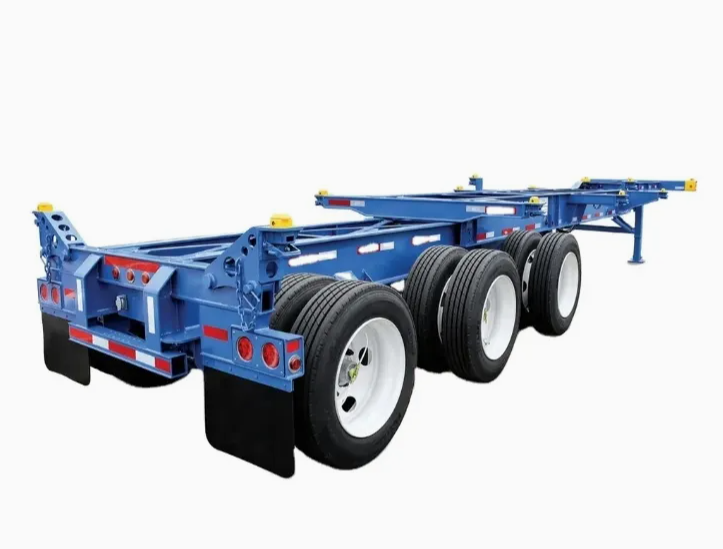
Not all chassis are interchangeable. The right type depends on the container sizes you move, the weight profile of your freight, and the roads you run on.
| Chassis Type | Best For | Key Feature | Limitation |
|---|---|---|---|
| Fixed 20ft Chassis | Dedicated 20ft container fleets | Short wheelbase, lightweight | Cannot handle 40ft boxes |
| Fixed 40ft Chassis | Standard dry van and reefer moves | Simple, lower cost | No flexibility for 20ft |
| Extendable Chassis | Mixed 20ft/40ft operations | Sliding or telescoping frame | Higher tare weight, more moving parts |
| Gooseneck Chassis | Height-restricted routes (Europe) | Stepped neck lowers deck height | Not suitable for all container types |
| Tri-Axle Heavy-Duty | Dense cargo, ISO tanks, rough yards | Higher payload, better weight distribution | Higher tare, more tire/brake maintenance |
Extendable chassis cost more upfront but eliminate the need for a second trailer if you handle both 20ft and 40ft containers regularly. Gooseneck designs are essential in markets where bridge or tunnel height limits restrict overall vehicle height; the stepped frame allows the container to sit lower over the rear axles.---
For heavy payloads or ISO tank containers, a tri-axle configuration spreads weight more effectively and improves stability. However, it also adds a third set of tires, brakes, and suspension components to maintain. If your operation stays within standard gross weight limits and runs primarily on paved highways, a tandem-axle chassis is often the more economical choice.-
Twist locks are the only thing holding your container to the chassis at highway speed. Yet buyers routinely assume that any chassis with “twist locks” will fit any container. That assumption causes accidents and costly rework.
Key specifications to verify before ordering:
Lock count and position: A standard 40ft chassis typically has four twist locks. Some configurations use eight or more for added security or for handling multiple container sizes. Extendable chassis require locks at multiple positions, and the locking mechanism must be positively engaged at each setting.-15
Manual vs. semi-automatic: Manual twist locks require the driver to physically rotate each lock. Semi-automatic or self-locking designs reduce driver fatigue and the risk of an improperly secured container, but cost more upfront.
Lock indicators: Visual or tactile indicators that show whether a lock is fully engaged are worth the small premium. A partially locked container can shift in transit.
Container compatibility: Confirm the lock positions match the container sizes you actually move. A chassis marketed as “40ft” may not accept a 20ft box without repositioning or additional lock sets.
Ask for the technical drawing of the twist lock layout before production begins. A reputable manufacturer will provide this without hesitation; a broker who cannot produce it is a risk you should not take.-
The running gear determines your maintenance cost per mile more than any other component.
| Component | Standard Option | Heavy-Duty Upgrade | When to Upgrade |
|---|---|---|---|
| Axle Brand | FUWA 13-ton | BPW 14–16 ton | 80,000+ km/year, rough roads |
| Suspension | Mechanical leaf spring | Air suspension (BPW/Hendrickson) | Fragile cargo, driver comfort, tire wear |
| Kingpin | 2-inch bolt-on | 3.5-inch welded | Heavy loads, frequent coupling |
| Landing Gear | Two-speed, 28-ton | JOST heavy-duty, 50-ton | Frequent drop-and-hook |
The axle decision deserves particular attention. A BPW axle adds roughly $1,500–2,000 per axle to the build cost, but service data from high-mileage fleets shows significantly fewer brake system repairs in the first three years compared to standard axles. If your chassis will accumulate high mileage on poorly maintained roads, the upgrade pays for itself. For port drayage and low-speed yard work, a standard axle with diligent maintenance is often sufficient.-12
Air suspension is worth considering if you haul fragile or high-value cargo, or if driver retention matters to your operation. It reduces road shock to the container and improves tire life. The trade-off is added complexity and potential air leak points.
The main beams carry the entire container load plus road shock and twisting forces from uneven surfaces. Cutting corners here is the most common reason chassis develop cracks and sag within a few years.
| Specification | Standard | Heavy-Duty | What It Means for You |
|---|---|---|---|
| Main Beam Steel | Q345B (~345 MPa yield) | Q460C / QSTE700 (≥460 MPa yield) | Higher yield = better resistance to bending and cracking |
| Beam Height | 450–500mm H-beam | 500–550mm deep-section | Taller beam = stiffer frame, better load distribution |
| Tare Weight (40ft, 3-axle) | 6.2–6.8 tonnes | 5.5–6.0 tonnes (high-strength steel) | Lower tare = more legal payload |
High-strength steel is not just about strength—it can also reduce tare weight while maintaining or improving load capacity. A lighter chassis means more revenue-generating payload per trip, provided the frame is engineered correctly.
Inspect the weld quality on any chassis before purchase, whether new or used. Look for consistent bead size, no undercutting, and no signs of post-weld grinding to hide defects. On used units, pay particular attention to the front pivot area, landing gear mounts, and crossmember-to-main-beam junctions—these are the first places cracks appear.14
Container chassis live hard lives. They sit in port yards exposed to salt air, run through rain and road spray, and spend years outdoors without shelter. A cheap paint job will fail within 18 months in a coastal environment, and once rust starts inside a box section, the frame’s strength degrades from the inside out.
Coating systems to compare:
| Coating Specification | Typical Lifespan (Coastal) | Suitability |
|---|---|---|
| Single-coat alkyd | 12–18 months | Inland, dry climates only |
| Two-coat (primer + topcoat) | 2–3 years | Moderate environments |
| Three-coat (zinc-rich primer + epoxy mid + polyurethane top) | 5+ years | Coastal, humid, salt-exposed operations |
Ask specifically how the steel is prepared before painting. Shot blasting to Sa 2.5 or better is the standard for a coating that will actually adhere. A manufacturer that skips surface preparation and sprays primer onto mill scale is selling a trailer that will look good on delivery day and show rust stains within a year.-6-12
If your chassis will operate near the coast, in the Gulf states, West Africa, or Southeast Asia, do not accept the standard paint specification. The cost difference for a proper three-coat system is modest compared to the cost of structural repair or early replacement.
Container chassis prices vary widely based on specification, origin, and order volume. The table below reflects typical FOB China pricing for new units, which dominate exports to Africa, the Middle East, and Southeast Asia.
| Configuration | FOB China Price (USD) | Notes |
|---|---|---|
| 20ft Skeleton, 2-axle | $5,000–6,500 | Entry-level port drayage |
| 40ft Skeleton, 3-axle (Standard) | $7,000–9,000 | Most common export spec |
| 40ft Skeleton, 3-axle (BPW axles) | $10,500–13,500 | Premium running gear |
| 45ft Skeleton, 3-axle | $8,500–11,000 | For 45ft container markets |
| Extendable (40–53ft), 3-axle | $12,500–16,000 | Maximum flexibility |
| Gooseneck, 3-axle | $9,000–12,000 | Height-restricted routes |
Note: Prices are indicative FOB Qingdao/Shanghai for Q2–Q3 2026. Freight and import duties are additional. Steel prices are volatile; a $50/tonne swing in hot-rolled coil can move trailer pricing by $200 or more.-
When comparing quotes, demand that each supplier itemize the major components: axle brand and rating, suspension type, tire brand and size, kingpin spec, landing gear capacity, and coating system. A quote that simply says “3-axle container chassis” is not a quote you can compare against another. The cheapest apparent price often reflects hidden downgrades in exactly the components that determine how long the trailer lasts.
Whether buying new or used, inspect the chassis yourself or hire an independent inspector. Do not rely solely on the seller’s word or a video walkaround.
For new chassis (factory inspection or pre-shipment):
Verify twist lock positions against the agreed technical drawing
Check main beam straightness with a string line
Inspect welds at all crossmember and bolster junctions
Confirm axle brand and model match the quotation
Test landing gear operation under load
Verify paint coverage in box sections and underframe
For used chassis (additional checks):
Look for cracks at weld toes, especially near the kingpin and suspension mounts
Check for rust scale or flaking that indicates section loss
Examine tire wear patterns for signs of frame misalignment
Test every twist lock for smooth operation and positive engagement
Inspect brake chambers, slack adjusters, and ABS function
Verify the VIN on the frame matches the documentation
Walk away from any chassis with unrepaired cracks in main beams, significant corrosion perforation, or a seller who refuses an independent inspection. Structural repairs to a container chassis are rarely economical, and a compromised frame is a safety risk that no discount justifies.3
What is the difference between a container chassis and a skeleton trailer?
They are the same thing. “Container chassis,” “skeleton trailer,” “skeletal trailer,” and “chassis” all refer to a bare frame semi-trailer with twist locks for securing shipping containers.-
Can a container chassis carry a 20ft and 40ft container?
Only if it is an extendable chassis or has twist locks positioned for both sizes. A fixed 40ft chassis cannot safely secure a 20ft container without repositioning locks, and many fixed designs do not accommodate the shorter box at all. Confirm lock positions before purchase.
How much does a container chassis trailer weigh?
A typical 40ft, 3-axle skeleton chassis weighs approximately 6.2–6.8 tonnes in standard specification. High-strength steel designs can reduce tare to 5.5–6.0 tonnes, increasing legal payload.-
What is the most important thing to check on a used container chassis?
Frame integrity. Check main beams, crossmembers, and all weld joints for cracks, bends, and corrosion. A chassis with a sound frame and worn tires is a better buy than a cosmetically clean unit with hidden structural damage.-
Do I need a tri-axle or tandem-axle chassis?
Tri-axle configurations are appropriate for heavy payloads, ISO tank containers, and operations where bridge laws or axle weight limits favor spreading load over more positions. Tandem axles are lighter, cheaper to maintain, and sufficient for standard dry container drayage within legal weight limits.-9
Final Word
A container chassis is a simple machine with a single job, but the details that separate a reliable trailer from a problem asset are all in the specification and the build quality. Define your container sizes, weight profile, and operating environment first. Then specify the frame steel, twist locks, axles, and coating to match—not the other way around. The lowest purchase price is rarely the lowest cost of ownership.


