
Views: 0 Author: Site Editor Publish Time: 2026-10-15 Origin: Site


HOWO vs SHACMAN: Compare engine performance, fuel consumption, durability, price, maintenance, and spare parts to choose the right heavy-duty truck for your business.
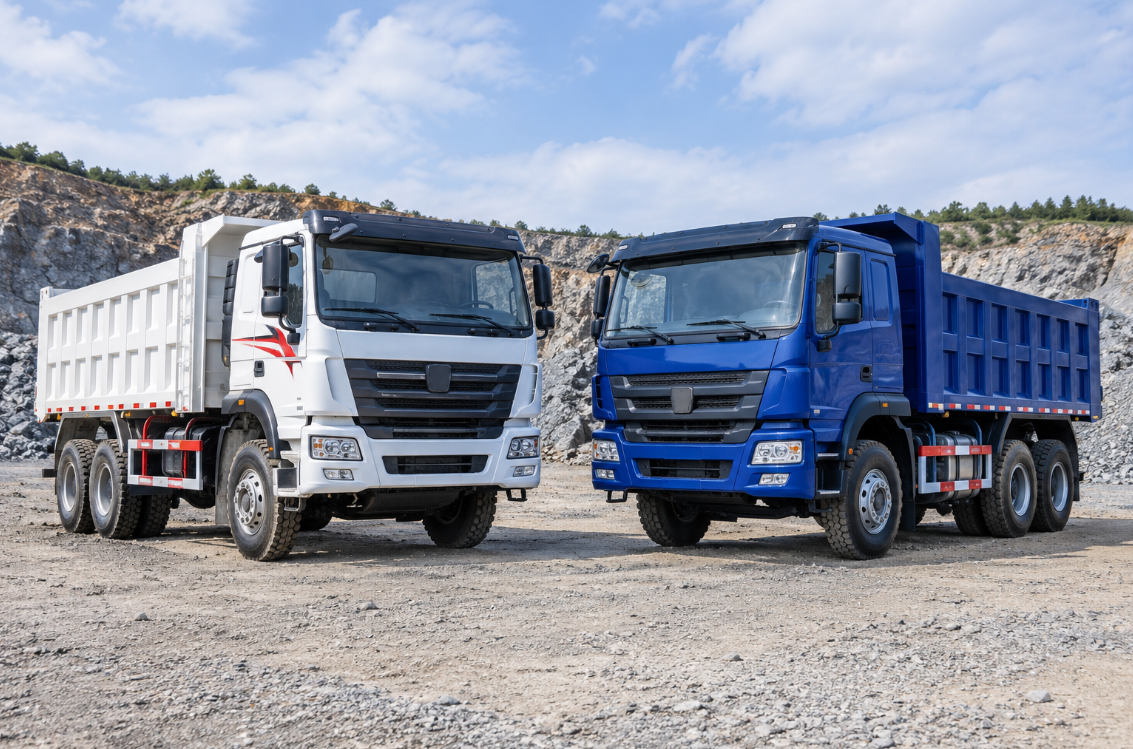
When purchasing a heavy-duty truck, many international buyers compare HOWO and SHACMAN. Both brands offer a range of trucks for demanding working conditions, including dump trucks, tractor trucks, cargo trucks, and specialized commercial vehicles.
HOWO is a truck brand under SINOTRUK, while SHACMAN is associated with Shaanxi Heavy Duty Automobile Co., Ltd. Both manufacturers offer multiple vehicle series and configurations, so comparing the brands alone does not reveal which truck will perform better for a particular job.
For example, a HOWO 6×4 dump truck configured for general construction should not be compared directly with a high-specification SHACMAN tractor designed for long-distance transport. Buyers need to compare vehicles with similar applications, rated loads, engine power, transmission, and operating requirements.
In this guide, we compare HOWO and SHACMAN across the factors that matter most to fleet owners, truck dealers, construction companies, mining contractors, and international vehicle importers.
HOWO is a commercial vehicle brand from SINOTRUK. Its product range includes dump trucks, tractor trucks, cargo trucks, and other commercial vehicles.
HOWO dump trucks are available in different axle configurations, engine outputs, cargo body sizes, and technical specifications. For example, SINOTRUK publishes 6×4 dump truck configurations with 340 HP, 380 HP, and 400 HP engine options, as well as selected 8×4 configurations. These are examples of listed configurations, not specifications shared by every HOWO model.
HOWO may be worth considering when buyers need:
A truck configured for general construction or material transportation.
Different engine, body, and chassis options.
A practical specification matched to the local operating environment.
A supplier able to provide technical documentation and export support.
SHACMAN offers heavy-duty trucks for construction, mining, long-distance transportation, and other commercial applications. Its product families include the F3000, X3000, X5000, and X6000 series, among others.
Specifications vary considerably between these series. For example, the official SHACMAN F3000 product information lists multiple drive configurations and Weichai or Cummins engine options. The X6000 range offers a different set of powertrain and cab configurations.
SHACMAN may be worth considering when buyers need:
A truck configured for demanding construction or mining work.
A choice of engine and transmission combinations.
Different cab and chassis specifications across model series.
A vehicle matched to a particular hauling route or fleet operation.
The best choice still depends on the exact model and available configuration.
| Comparison Factor | HOWO | SHACMAN |
|---|---|---|
| Manufacturer | SINOTRUK | Shaanxi Heavy Duty Automobile |
| Main applications | Construction, mining, logistics, and commercial transport | Construction, mining, logistics, and commercial transport |
| Product range | Dump trucks, tractor trucks, cargo trucks, and specialized vehicles | Dump trucks, tractor trucks, cargo trucks, and specialized vehicles |
| Engine options | Vary by model and market | Vary by model and market |
| Transmission | Model-dependent manual or other available configurations | Model-dependent manual, AMT, or other available configurations |
| Axle configurations | Multiple options, depending on vehicle type | Multiple options, depending on vehicle type |
| Fuel consumption | Depends on the complete vehicle specification and duty cycle | Depends on the complete vehicle specification and duty cycle |
| Spare parts | Availability depends on the country, model, and local distribution network | Availability depends on the country, model, and local distribution network |
| Purchase price | Depends on model, specification, and sales terms | Depends on model, specification, and sales terms |
| Best selection method | Compare equivalent vehicles for the intended job | Compare equivalent vehicles for the intended job |
Key takeaway: There is no reliable universal winner. The better truck is the one that meets your technical requirements and delivers the most suitable operating cost over its service life.
Engine performance is one of the first factors buyers consider when comparing heavy-duty trucks. However, horsepower alone is not enough to determine which truck is better.
Buyers should compare:
Maximum engine power.
Maximum torque and the engine speed at which it is available.
Engine displacement and fuel system.
Transmission ratios.
Rear axle ratio.
Loaded vehicle weight and route gradients.
Emission standard and fuel requirements.
| Item | HOWO | SHACMAN |
|---|---|---|
| Engine brands and families | Vary by model; selected trucks use Weichai and other manufacturer-specific powertrains | Selected trucks use Weichai or Cummins engines |
| Available horsepower | Model- and market-dependent | Model- and market-dependent |
| Low-speed pulling performance | Depends on engine torque and gearing | Depends on engine torque and gearing |
| Fuel economy | Depends on engine calibration, load, route, and driving style | Depends on engine calibration, load, route, and driving style |
| Maintenance requirements | Follow the specific engine manufacturer's schedule | Follow the specific engine manufacturer's schedule |
For reference, SINOTRUK lists a HOWO 6×4 dump truck with a 380 HP Weichai WP10 engine in one published configuration. SHACMAN's official F3000 specifications cover a broader range of power options depending on the selected configuration.
These examples are not a direct performance test. For an accurate comparison, request the complete engine code, torque curve, transmission model, axle ratio, and rated vehicle weights for both trucks.
Neither brand should be selected solely by horsepower. A truck with a suitable torque curve and transmission ratio can perform better on a specific steep route than a more powerful truck configured for a different duty cycle.
For mining or hilly terrain, pay particular attention to:
Starting ability under load.
Low-speed torque.
Gear selection and axle ratio.
Engine cooling under sustained heavy operation.
Engine braking and any required auxiliary braking equipment.
For long-distance transport, consider cruising efficiency, engine speed at typical operating speeds, transmission performance, and the expected proportion of highway driving.
Fuel consumption directly affects the operating cost of a commercial truck. However, it is not accurate to state that every HOWO truck consumes less fuel than every SHACMAN truck, or vice versa.
Fuel consumption depends on several variables:
Vehicle model and engine specification.
Gross operating weight and payload.
Distance and route gradient.
Road surface and traffic.
Tire type and inflation pressure.
Transmission and axle ratio.
Driver behavior and idling time.
Maintenance condition and fuel quality.
Ask both suppliers to identify the exact truck configuration and explain the operating assumptions behind any fuel-consumption estimate.
Where possible, compare actual fleet data from trucks working under similar conditions. A construction truck making frequent short trips should not be compared with a highway tractor operating on relatively flat roads.
For fleet operators, fuel cost per tonne transported or per completed trip can be more informative than fuel consumption alone.
Example calculation:
If a truck consumes 35 litres per 100 km and travels 200 km in a working day, estimated fuel use is:
35 × 200 ÷ 100 = 70 litres per day.
This is an illustration only, not a claimed fuel-consumption figure for either brand. Actual consumption must be measured under the relevant operating conditions.
Chassis and axle specifications are especially important for dump trucks working in construction sites, quarries, and mining areas.
Both HOWO and SHACMAN offer vehicles with different chassis and axle configurations. The correct choice depends on the intended load, terrain, operating cycle, and permitted axle weights.
| Component | Key questions |
|---|---|
| Chassis frame | What are the frame dimensions, material specification, and reinforcement design? |
| Front axle | What is the rated capacity and axle model? |
| Rear axles | What are the rated capacities, ratio, and differential-lock options? |
| Suspension | Is it designed for the expected load and road conditions? |
| Tires | Are the size, load rating, and tread suitable for the terrain? |
| Braking system | Does it meet the destination market's requirements? |
| Ground clearance | Is it suitable for site entrances, uneven roads, and obstacles? |
The answer depends on the exact configuration, not just the brand name.
For rough construction roads or mining routes, evaluate chassis reinforcement, suspension design, tire specifications, ground clearance, and protection of vulnerable components.
SHACMAN's official F3000 Super Edition information highlights application-specific changes for demanding terrain and mining operations. HOWO also provides different dump truck specifications and manufacturer guidance for selecting vehicles according to working conditions.
Do not assume that every vehicle sold under either brand is suitable for severe off-road use. Ask the supplier to confirm the intended operating environment and the limits of the quoted configuration.
Dump trucks need to withstand repeated loading and unloading, variable payloads, and often difficult site conditions. In this application, the body, hydraulic system, chassis, and axle configuration are as important as the engine.
| Application | What to Prioritize | Practical Buying Advice |
|---|---|---|
| General construction | Balanced power, maneuverability, and operating cost | Compare equivalent 6×4 configurations |
| Sand and gravel transport | Payload compliance, body volume, and unloading efficiency | Calculate material weight and volume separately |
| Quarry operations | Body wear resistance, chassis suitability, and tire durability | Confirm the actual rock size and loading method |
| Mining haulage | Axle ratings, frame design, torque, cooling, and ground clearance | Request a mining-oriented specification |
| Hilly routes | Torque, gearing, braking, and cooling | Review the route gradient and loaded operating weight |
| Long-distance bulk transport | Fuel economy, comfort, and service access | Compare complete operating costs and service coverage |
SINOTRUK publishes a HOWO 6×4 dump truck specification with a 380 HP engine and selected cargo body volumes of 16, 18, or 20 cubic metres. Its published HOWO 8×4 configuration lists larger body-volume options, depending on the specification.
These figures illustrate the available configurations on the cited product pages. They should not be treated as universal capacities or as proof that one brand can legally carry more than the other.
SHACMAN's F3000 range includes 6×4 and 8×4 configurations and engine options that vary by market and specification. Buyers should request the precise model data sheet, including rated gross weight, axle capacities, cargo body dimensions, and hydraulic equipment.
If your main work involves general construction, compare the purchase price, service availability, payload compliance, and operating costs of equivalent models.
If you operate in a mine or quarry, prioritize the chassis, axle ratings, body wear resistance, cooling, tires, and hydraulic lifting system. Ask for a specification specifically designed for the working conditions rather than choosing based on the badge on the cab.
Tractor trucks have different priorities from dump trucks. Their performance depends on the tractor unit, the trailer, the combined vehicle weight, and the route.
For long-distance logistics, buyers should compare:
Engine torque and power.
Transmission type and ratios.
Rear axle ratio.
Fifth-wheel rating and compatibility.
Gross combination weight and local regulations.
Fuel tank capacity and expected range.
Cab comfort and driver rest facilities.
Service coverage along the operating route.
The SHACMAN X6000 is one example of a product series offering multiple powertrain and transmission configurations. HOWO also has tractor models with different engine outputs and drivetrain specifications.
Do not compare a premium long-haul tractor against a basic construction tractor without accounting for the difference in equipment and intended use.
For international buyers, verify that the tractor's fifth wheel, electrical connections, braking connections, and other interfaces are compatible with the intended semi-trailer.
A truck's performance over several years depends not only on its original quality but also on how quickly it can be serviced when something goes wrong.
A low purchase price may not represent good value if critical components are difficult to obtain or repair times are long.
| Factor | What to Verify |
|---|---|
| Local availability | Are common filters, brake components, clutch parts, and service items stocked locally? |
| Engine parts | Are parts available for the exact engine code? |
| Transmission parts | Can the local workshop service the selected gearbox? |
| Axle parts | Are seals, bearings, and other service components accessible? |
| Diagnostic support | Can local technicians diagnose electronic systems, if fitted? |
| Warranty | What is covered, for how long, and under what conditions? |
| Technical support | Is remote troubleshooting or repair guidance available? |
| Parts delivery | What are the realistic lead times for items not stocked locally? |
There is no single answer for every country. Availability can differ between cities, dealers, model series, and engine configurations.
Before purchasing, ask local fleet operators and repair workshops which models they support regularly. Check the availability of common service items and major components rather than relying only on general brand popularity.
If you are buying several trucks, consider requesting an initial spare parts package based on the manufacturer's maintenance recommendations and your operating environment.
HOWO and SHACMAN prices vary with the vehicle model, powertrain, axle configuration, emission standard, body specification, new or used condition, and commercial terms.
A fair comparison requires two quotations with equivalent specifications.
A practical TCO assessment should include:
| Cost Category | Questions to Ask |
|---|---|
| Purchase price | Does the quotation include all agreed equipment? |
| Freight and insurance | Are shipping, marine insurance, and destination charges included? |
| Import duties and taxes | What charges apply in the destination country? |
| Fuel | What is the expected consumption under the actual duty cycle? |
| Maintenance | What are the routine service intervals and costs? |
| Repairs | Are parts and technicians readily available? |
| Downtime | How much could an unavailable truck cost the business? |
| Resale value | Is there a local market for the selected configuration? |
A lower initial price does not always mean a lower lifetime cost. A truck that consumes slightly more fuel but has easier local service access may be preferable in some operations. In other cases, a lower-priced configuration may be the best choice if it meets the technical requirements and has adequate parts support.
Make sure the quotations specify:
Exact model and manufacturing year.
New or used condition.
Engine code, horsepower, and emission standard.
Transmission and axle specifications.
Tire size and brand.
Cargo body dimensions and materials, if applicable.
Steering position.
Included spare parts and warranty.
Delivery terms and shipment arrangements.
Payment terms and delivery schedule.
This makes it easier to identify differences that may otherwise be hidden in a headline price.
These regions contain very different operating environments, regulations, and service networks. The best choice depends on the specific country and project.
For construction and mining operations, consider road quality, dust, ambient temperatures, fuel quality, payload requirements, and local repair capabilities.
Before ordering, verify the required steering position, emission standard, tire availability, and local axle-weight limits. Where road conditions are demanding, request a configuration suitable for the actual route rather than assuming that a standard truck will be sufficient.
High ambient temperatures and long-distance transport can make cooling performance, air conditioning, fuel economy, and maintenance access important.
Buyers should also confirm local vehicle approval, emission requirements, and any project-specific specifications before ordering.
Buyers should consider a mixture of urban traffic, construction sites, mountainous routes, rainfall, and muddy working conditions, depending on the country and project.
Check the permitted vehicle dimensions and weights, steering configuration, import rules, and local parts availability.
Important: Do not assume that one emission standard, steering position, or vehicle configuration is acceptable across an entire region. Requirements must be checked for the destination country and, where relevant, the end user's project.
Both brands may be available as new or used vehicles through different suppliers and markets. The right choice depends on budget, required configuration, delivery schedule, and maintenance capability.
| Factor | New Truck | Used Truck |
|---|---|---|
| Initial cost | Usually higher | Often lower |
| Configuration | May offer more customization | Limited to available stock |
| Wear and tear | Generally lower at delivery | Depends on condition and maintenance |
| Vehicle history | New vehicle documentation | Requires verification |
| Warranty | Depends on written terms | May be limited or unavailable |
| Delivery | Depends on stock or production | Depends on availability and inspection |
For used trucks, inspect the engine, transmission, chassis, suspension, tires, braking system, and any hydraulic equipment. Request the VIN, manufacturing year, maintenance records where available, and a written condition report.
A used vehicle should be evaluated on its actual condition, not simply on its brand or age.
A HOWO dump truck and a SHACMAN tractor truck have different jobs. Compare vehicles in the same category with similar specifications.
Horsepower must be considered alongside torque, gearing, payload, and route conditions.
Cargo volume and payload are different. Dense materials can reach the permitted weight limit before the body is full.
Confirm parts availability for the exact engine, gearbox, and axle specification.
Include shipping, taxes, fuel, maintenance, downtime, and expected repairs in the comparison.
Verify the exact vehicle documentation and destination-country rules before making a deposit.
Record the agreed configuration, equipment, warranty, delivery schedule, and inspection criteria in the quotation or sales contract.
Before deciding, answer these questions:
What will the truck transport?
Is it a dump truck, tractor truck, or cargo truck?
What payload or combination weight is required?
Will it operate on highways, construction sites, or mine roads?
Which engine power and torque range suit the route?
What transmission and axle ratio are required?
Which steering position and emission standard are permitted?
Are spare parts and qualified repair services available locally?
What are the total landed cost and expected operating costs?
Has the supplier provided a detailed specification sheet?
Have the warranty, payment, delivery, and inspection terms been confirmed in writing?
If you can answer these questions, you can compare the two brands more objectively and avoid choosing a truck based only on appearance or price.
For international buyers, selecting the right supplier is as important as selecting the truck. An experienced export supplier should help clarify the application, compare suitable configurations, prepare technical documents, and explain delivery terms.
Hunan Chengxin Special Vehicle Co., Ltd. supports commercial vehicle export enquiries and helps buyers review vehicle requirements for construction, mining, logistics, and other transport applications.
When requesting a quotation, provide your destination country, required quantity, preferred brand or model, intended application, payload requirements, engine and emission requirements, and steering position. If you are comparing HOWO and SHACMAN, ask for equivalent specifications so that the quotation comparison is meaningful.
Neither brand is universally better. The best option depends on the specific model, operating conditions, local service network, spare parts availability, and total cost of ownership.
SHACMAN offers configurations designed for demanding construction and mining applications, including selected F3000 models. However, suitability depends on the exact vehicle specification, payload, road conditions, and maintenance support. A properly configured HOWO may also be suitable for many mining applications.
Fuel efficiency depends on the engine, transmission, axle ratio, payload, route, and driving style. Compare real-world data from similar vehicles operating under similar conditions.
There is no fixed brand-wide price difference. Prices vary with the model, engine, equipment, emission standard, vehicle condition, and delivery terms. Compare equivalent quotations.
Availability varies by country, city, model, and engine specification. Check with local distributors and repair workshops before ordering, and verify the supply of essential service parts.
Some models and configurations may be offered with right-hand drive, but availability depends on the vehicle and market. Confirm the exact configuration and destination-country regulations with the supplier.
Start with the intended application and legal payload. Then compare the complete powertrain, chassis, axle configuration, service network, and total operating cost.
HOWO and SHACMAN both offer heavy-duty truck options for construction, mining, and commercial transportation. The better purchase is not necessarily the truck with the highest horsepower, lowest advertised price, or most familiar badge.
Instead, compare the exact vehicle specifications, confirm local compliance, assess spare parts availability, and estimate the total cost of ownership.
For dump trucks, pay special attention to payload, body design, hydraulic lifting equipment, chassis, and axle ratings. For tractor trucks, focus on the powertrain, fifth-wheel compatibility, combined vehicle weight, fuel economy, and driver requirements.
Need help comparing HOWO and SHACMAN trucks for your project? Contact Hunan Chengxin Special Vehicle Co., Ltd. with your destination country and operating requirements to discuss suitable configurations and request a quotation.


