
Views: 0 Author: Site Editor Publish Time: 2026-08-13 Origin: Site


Discover why lowbed semi-trailers are ideal for heavy equipment transport in Africa. Learn about lowbed trailer dimensions, load capacity, axle configurations, suspension, applications, road conditions, and buying tips for African markets.
Africa's construction, mining, infrastructure, agriculture, and energy industries require the frequent transportation of heavy and oversized machinery. Excavators, bulldozers, wheel loaders, graders, cranes, mining equipment, and other large machines often cannot be transported efficiently using conventional flatbed trailers.
A lowbed semi-trailer provides a practical solution.
With its low loading platform, strong structural frame, high load capacity, and flexible axle configurations, a lowbed trailer is designed specifically for transporting heavy equipment while helping control the overall transport height.
For African operators, however, choosing a lowbed trailer is not simply about selecting the highest advertised payload. Road conditions, axle-load regulations, cargo dimensions, maintenance requirements, spare parts, and the actual distribution of the equipment's weight all need to be considered.
This guide explains how to select a suitable heavy-duty lowbed semi-trailer for Africa.
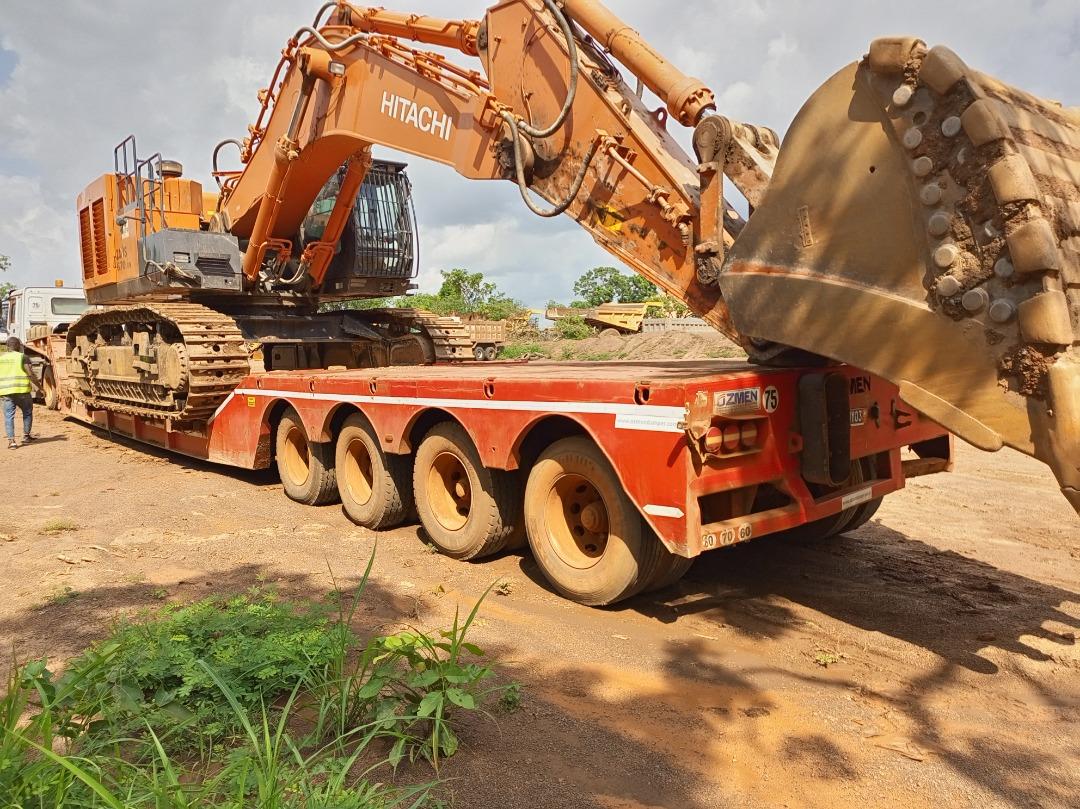
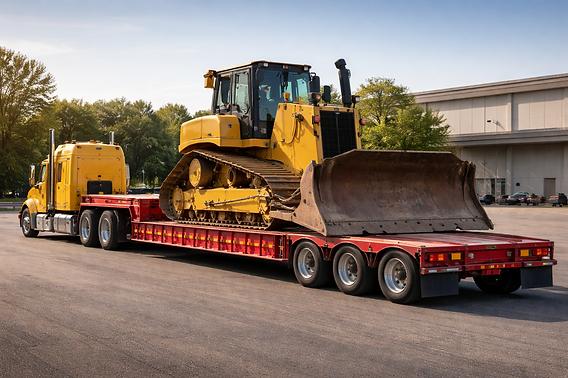
A lowbed semi-trailer is a specialized trailer with a low loading deck designed to transport heavy machinery and oversized equipment.
Unlike a conventional flatbed trailer, the lowbed's deck is positioned closer to the road surface. This lowers the center of gravity and helps reduce the overall height of the loaded vehicle.
Typical cargo includes:
Excavators
Bulldozers
Wheel loaders
Motor graders
Road rollers
Cranes
Mining machinery
Agricultural machinery
Industrial equipment
A semi-trailer transfers part of its loaded weight to the tractor through the kingpin and fifth wheel.
Africa has a wide range of operating environments, from modern highways and urban construction projects to mining areas and remote roads.
The African Development Bank has specifically highlighted the importance of axle-load control and cross-border road transport efficiency in African corridors.
This makes trailer selection particularly important.
Strong chassis construction
Appropriate axle configuration
High ground clearance where required
Reliable mechanical suspension
Easy maintenance
Good availability of replacement parts
Suitable braking systems
Proper cargo securing points
Configuration compatible with local regulations
A good lowbed trailer should therefore be designed for the actual operating environment, rather than simply maximizing theoretical payload.
The low deck helps reduce the total height of the tractor-trailer combination when carrying tall machinery.
This is especially useful for excavators, loaders, cranes, and other equipment with significant overall height.
Heavy-duty lowbed trailers can be configured with multiple axles and reinforced frames for high-weight cargo.
Many lowbed trailers use rear ramps, allowing wheeled or tracked machinery to drive directly onto the deck.
Multiple axles help distribute heavy cargo over a larger number of road contact points.
However, the actual permissible payload still depends on axle ratings, cargo position, tractor capacity, and local regulations. UNECE guidance emphasizes that payload can change significantly depending on the cargo's longitudinal center of gravity.
There is no single universal lowbed trailer specification for all African countries. Dimensions and permissible weights must be confirmed according to the destination country's regulations and the customer's cargo.
The following table represents common manufacturer configuration ranges, not legal limits:
| Specification | Typical Range / Options |
|---|---|
| Trailer Length | Approx. 10–16 m |
| Trailer Width | Approx. 2.5–3.2 m |
| Deck Length | Approx. 6–12 m |
| Axles | 2–5+ axles |
| Typical Payload Range | Approx. 30–100+ tons |
| Suspension | Mechanical / Air |
| Main Beam | High-strength structural steel |
| Loading Method | Rear ramps / detachable gooseneck depending on design |
| Brake System | Air brake system |
| Tires | Market-dependent |
| Kingpin | Standard or customized |
Important: A trailer's advertised "60-ton" or "80-ton" capacity should not automatically be interpreted as the legally permissible road payload. UNECE defines load capacity as the maximum goods weight declared permissible by the competent authority of the vehicle's registration country.
A higher number of axles generally allows the trailer to distribute heavy loads more effectively, but the axle configuration should be selected according to the cargo and local regulations.
| Configuration | Typical Manufacturer Payload Range* | Common Application |
|---|---|---|
| 2 Axles | 30–40 tons | Medium construction equipment |
| 3 Axles | 40–60 tons | Excavators, loaders, bulldozers |
| 4 Axles | 60–80 tons | Heavy construction and mining equipment |
| 5 Axles | 80–100+ tons | Heavy industrial machinery |
| Multi-Axle | 100+ tons | Specialized project cargo |
*These are typical configuration ranges for product planning, not universal legal payload limits.
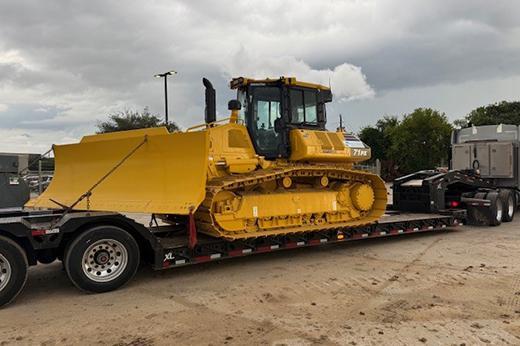
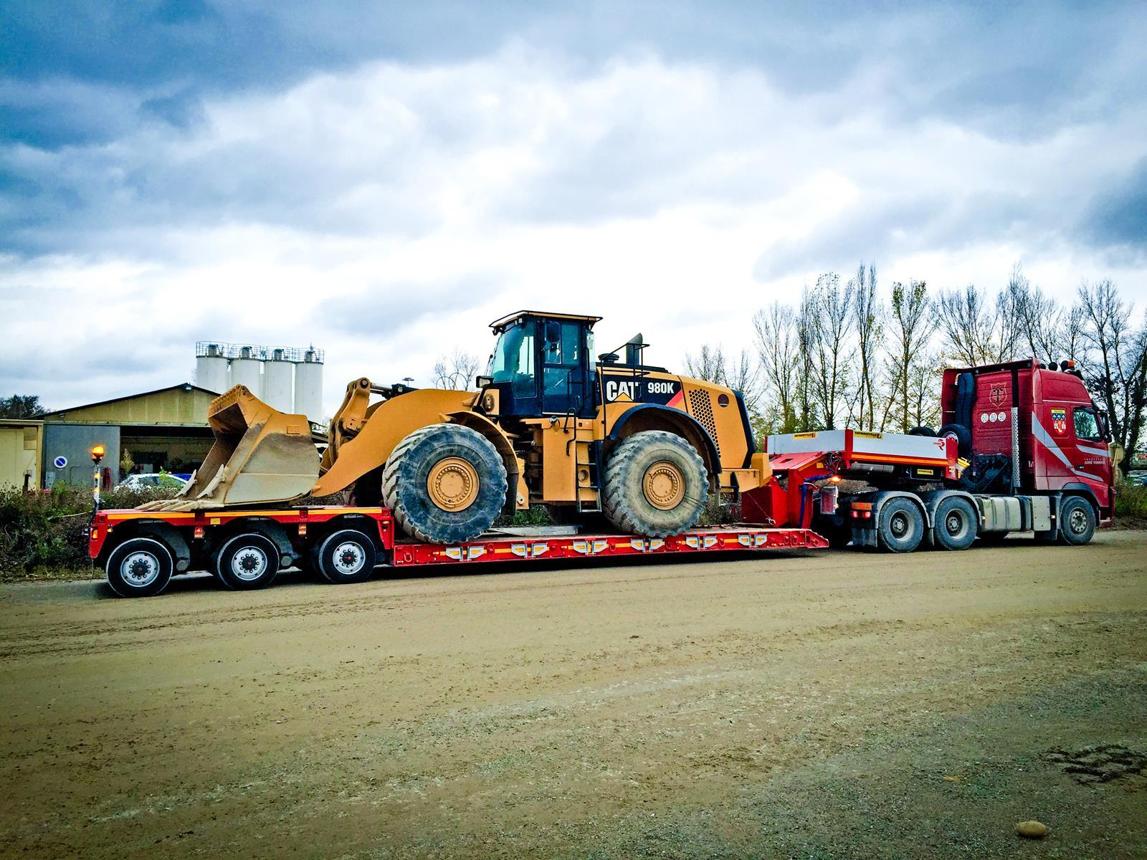
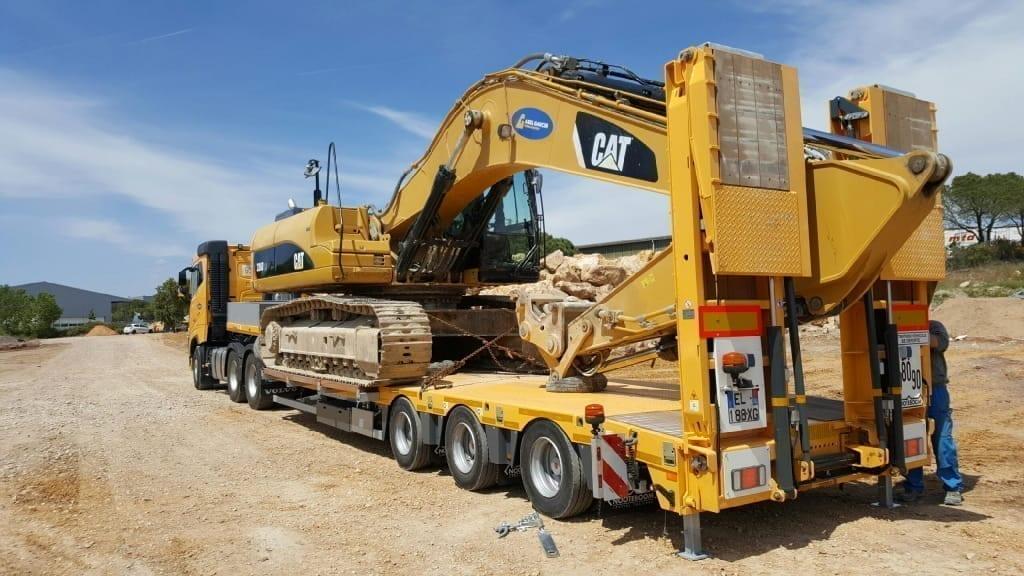
Excavators are among the most common loads for lowbed trailers.
Before transportation, the operator should consider:
Operating weight
Overall height
Track width
Boom position
Center of gravity
Attachment configuration
Bulldozers are heavy and often have a relatively high center of gravity. A low deck can help reduce the overall transport height.
Wheel loaders are often suitable for ramp loading because they can drive onto the trailer under their own power.
Mining operations may require trailers with:
Higher payload capacity
Reinforced frames
More axles
Heavy-duty suspension
Robust tires
Strong cargo securing points
When purchasing a lowbed trailer, don't only ask for the overall trailer length.
You should request the complete dimensional drawing.
Overall length
Overall width
Deck length
Deck width
Deck height
Ground clearance
Ramp angle
Kingpin position
Axle spacing
Gooseneck dimensions
Suppose a piece of construction equipment is already very tall. Adding a high trailer deck can push the total transport height beyond the legal limit.
The lower loading platform of a lowbed trailer helps solve this problem.
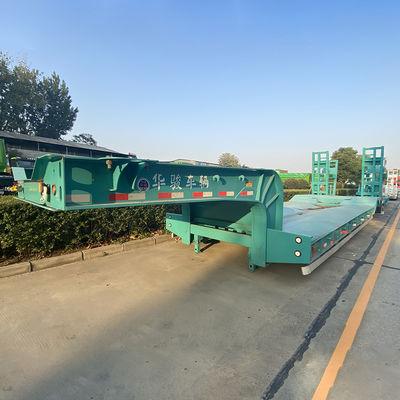
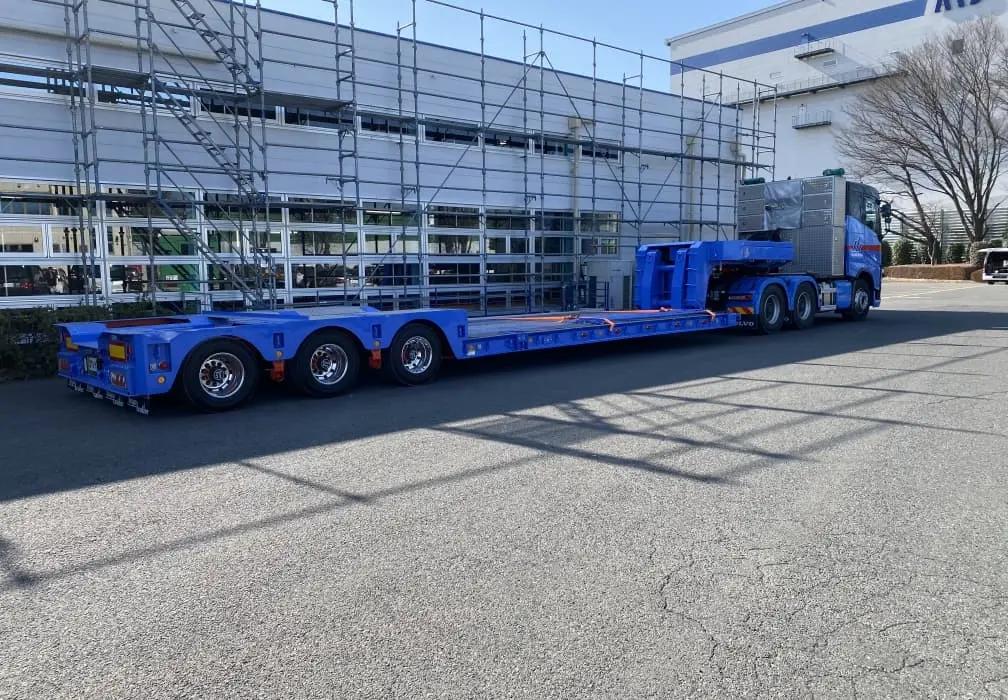
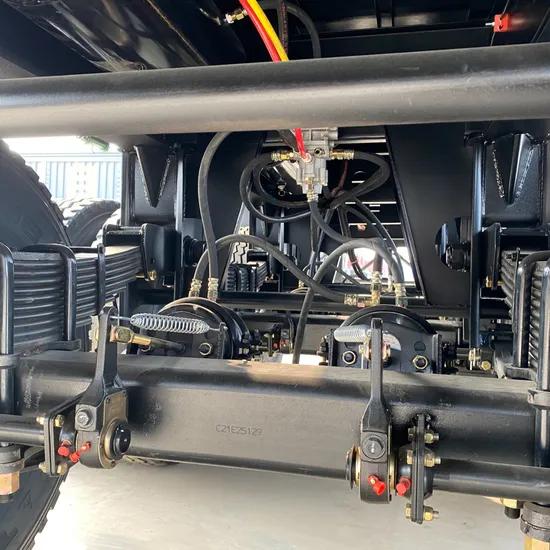
For many African heavy-equipment applications, suspension selection should reflect road conditions, maintenance capability, and operating costs.
| Feature | Mechanical Suspension | Air Suspension |
|---|---|---|
| Structure | Relatively simple | More complex |
| Initial Cost | Generally lower | Generally higher |
| Maintenance | Easier | More components |
| Rough Road Applications | Good | Application-dependent |
| Ride Comfort | Good | Better |
| Heavy-Duty Applications | Excellent | Excellent |
| Spare Parts | Generally easier to source | Depends on market |
For remote mining and construction operations, mechanical suspension can be attractive because of its relatively simple structure and ease of maintenance.
One of the biggest mistakes when purchasing a trailer for Africa is using exactly the same specification designed for a highway-only market.
Different African markets have different:
Road conditions
Maximum axle loads
Vehicle dimension regulations
Climate
Maintenance capabilities
Spare-parts availability
Cross-border transport requirements
Therefore, the trailer should be customized according to the destination.
The main frame should be designed to handle repeated heavy loading.
Cross members help distribute cargo loads across the trailer structure.
For demanding road conditions, suspension durability is especially important.
The trailer should provide sufficient clearance for the intended roads without unnecessarily increasing deck height.
Heavy equipment requires a properly matched braking system for the tractor-trailer combination.
A strong trailer alone does not guarantee safe transportation.
The machinery must be correctly positioned and secured.
UNECE guidance notes that road vehicles are particularly sensitive to cargo center-of-gravity position because axle loads affect steering and braking performance.
Chains
Heavy-duty straps
Wheel chocks
Blocking
Securing rings
Mechanical restraints
The exact securing method should be selected according to the machine, trailer design, road conditions, and applicable regulations.
| Feature | Lowbed Semi-Trailer | Flatbed Semi-Trailer |
|---|---|---|
| Deck Height | Low | Higher |
| Heavy Machinery | Excellent | Good |
| Tall Equipment | Excellent | Less suitable |
| Container Transport | Limited | Excellent |
| General Cargo | Good | Excellent |
| Loading Machinery | Excellent | Good |
| Overall Transport Height | Lower | Higher |
| Main Application | Heavy equipment | General cargo & containers |
If your business mainly transports excavators, bulldozers, loaders, graders, cranes, and mining equipment, a lowbed trailer is usually the more appropriate choice.
If your main cargo is containers, steel products, timber, and general cargo, a flatbed trailer may offer greater flexibility.
Before requesting a quotation from a manufacturer, prepare the following information.
Provide:
Equipment type
Operating weight
Overall length
Overall width
Overall height
Track/wheel width
Center of gravity if available
Tell the manufacturer the exact country where the trailer will operate.
For example:
Nigeria
Ghana
Kenya
Tanzania
Zambia
Zimbabwe
Ethiopia
Uganda
South Africa
This is important because permissible dimensions and axle loads can differ between jurisdictions.
Explain whether the trailer will mainly operate on:
Highways
Urban roads
Construction sites
Mining roads
Rural roads
Cross-border corridors
Do not simply tell the manufacturer:
"I need a 60-ton trailer."
Instead, provide the actual equipment weight and dimensions.
The manufacturer can then recommend the appropriate axle configuration and structural design.
A trailer may theoretically be designed for a high payload, but that does not mean the combination can legally carry that weight everywhere.
UNECE guidance states that the maximum permissible gross mass of a semi-trailer can depend on the tractor used and the country where the vehicle operates.
African countries and regional corridors also continue to focus on axle-load management. For example, the African Development Bank has supported axle-load control initiatives and harmonization work in African transport corridors.
Therefore:
Trailer capacity ≠ automatically legal road payload.
Always check the destination country's regulations before finalizing the specification.
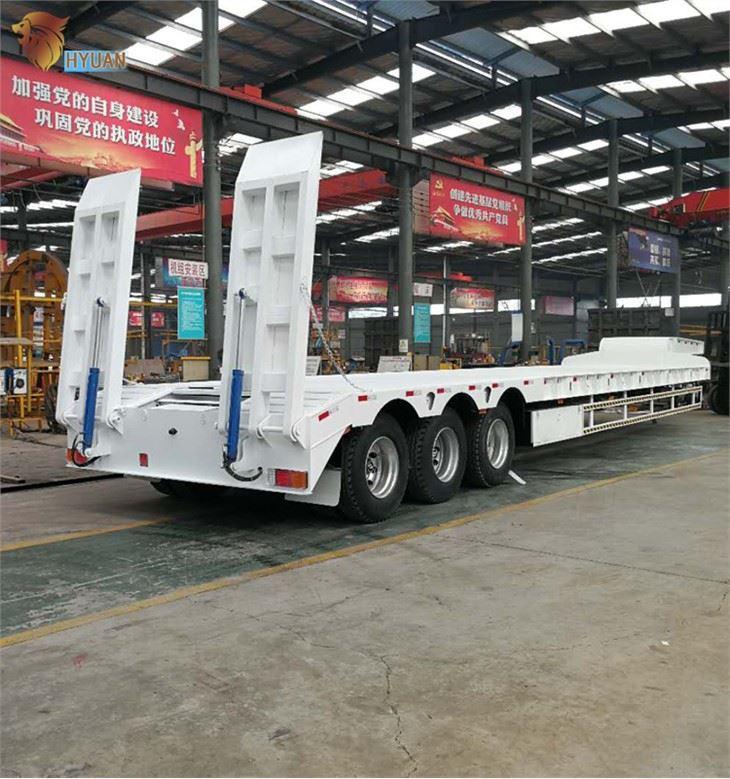
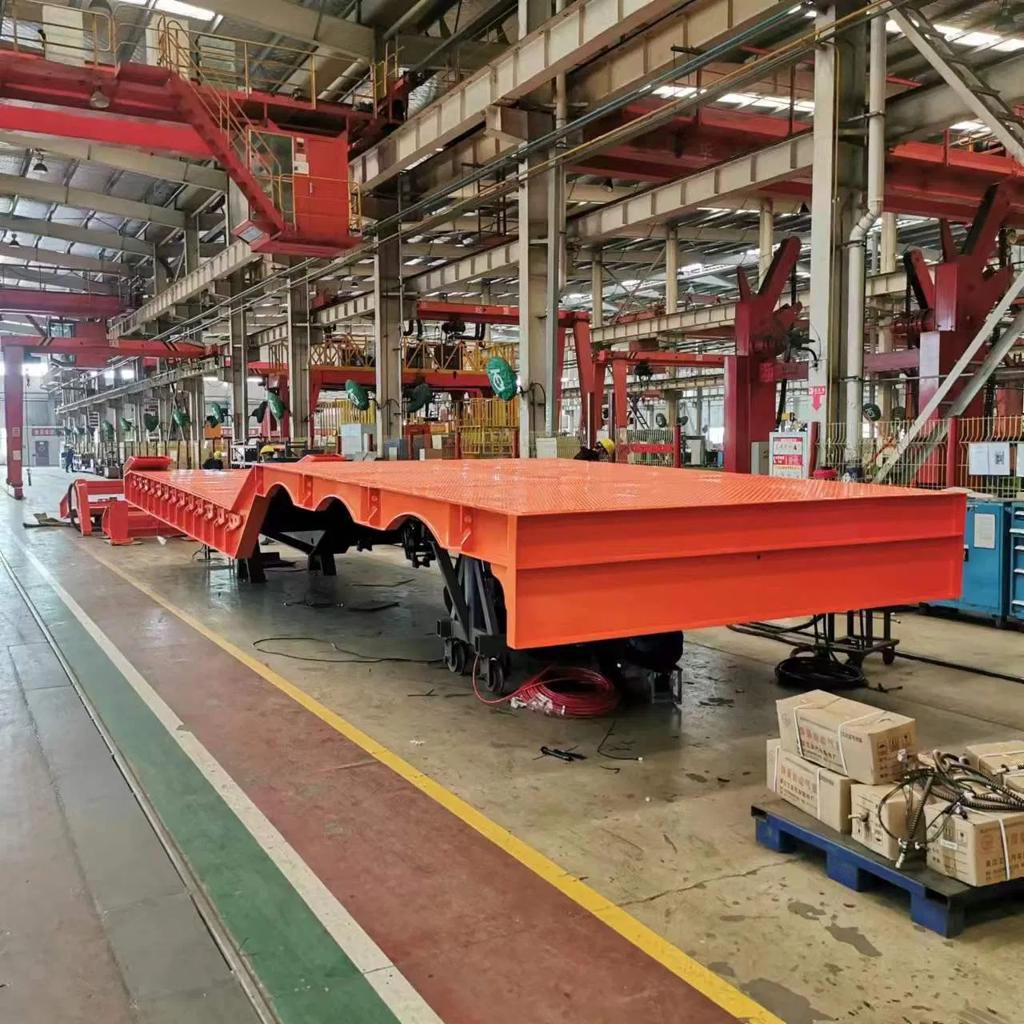
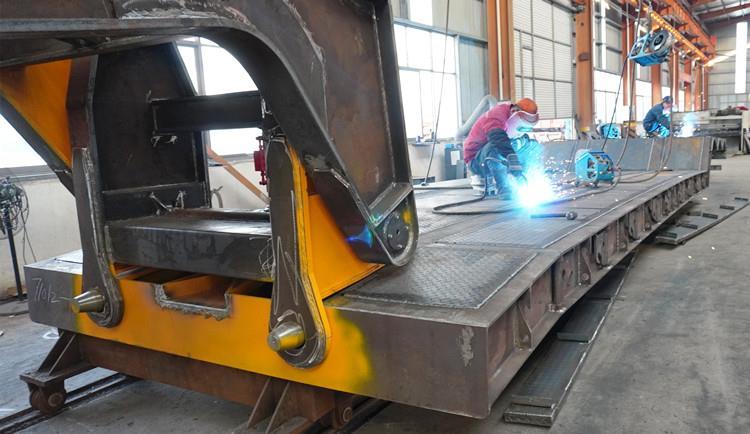
A professional manufacturer can customize the lowbed according to the customer's application.
| Customization | Available Options |
|---|---|
| Trailer Length | Standard / Customized |
| Deck Width | Standard / Customized |
| Axles | 2 / 3 / 4 / 5+ |
| Suspension | Mechanical / Air |
| Payload | Application-dependent |
| Ramps | Hydraulic / Mechanical |
| Main Beam | Standard / Reinforced |
| Tires | Different sizes and brands |
| Landing Gear | Different brands |
| Kingpin | Customized |
| Paint | Customer color |
| Logo | OEM branding |
| Spare Tire Carrier | Optional |
Hunan Chengxin Special Vehicle Co., Ltd manufactures semi-trailers and provides customized transportation solutions for international customers.
For African customers, a trailer should be configured according to the actual working environment rather than using a one-size-fits-all specification.
Heavy-duty lowbed semi-trailers
2–5+ axle configurations
Mechanical and air suspension options
OEM customization
Different deck lengths and widths
Reinforced structural designs
Technical drawings
Export documentation support
Spare-parts support
The company's product range also includes flatbed semi-trailers, sidewall trailers, container chassis, dump semi-trailers, tank trailers, and other transportation equipment.
Before placing an order, African buyers should check:
| Item | What to Verify |
|---|---|
| Main Beam | Steel grade and dimensions |
| Cross Members | Quantity and structure |
| Axles | Rated capacity and manufacturer |
| Suspension | Type and capacity |
| Tires | Size and load rating |
| Brake System | Configuration and components |
| Kingpin | Rating and standard |
| Landing Gear | Rated capacity |
| Deck | Thickness and structure |
| Ramps | Length, angle and capacity |
| Cargo Securing | Rings / hooks / restraints |
| Dimensions | Technical drawing |
| Payload | Rated capacity |
| Local Compliance | Destination regulations |
| Warranty | Coverage and terms |
A lowbed semi-trailer is primarily used to transport heavy and oversized machinery such as excavators, bulldozers, wheel loaders, graders, cranes, and mining equipment.
Depending on the configuration, lowbed trailers can be manufactured for different payload classes, commonly from around 30 tons to 100 tons or more. The actual permissible road payload depends on the trailer, tractor, axle ratings, cargo distribution, and local regulations.
Yes, but the specification should be adapted to the destination market. Mechanical suspension, robust structural design, appropriate ground clearance, reliable braking, and accessible spare parts can be important for demanding applications.
There is no universal answer. A 3-axle configuration may be suitable for many medium-heavy machines, while 4-, 5-, or multi-axle configurations may be appropriate for heavier equipment. The choice should be based on cargo weight, axle-load limits, and local regulations.
Yes. Excavators are among the most common types of machinery transported on lowbed trailers. Buyers should provide the excavator's actual operating weight and dimensions so the trailer can be correctly configured.
A lowbed semi-trailer is one of the most practical solutions for heavy equipment transport in Africa, particularly for construction, mining, infrastructure, agriculture, and industrial projects.
Its low deck, strong structure, multiple axle options, and flexible loading design make it suitable for transporting large machines that are difficult to move with conventional trailers.
However, the best lowbed trailer is not necessarily the one with the highest advertised payload. A successful specification should balance:
Cargo weight + cargo dimensions + axle load + road conditions + local regulations + maintenance requirements.
For African buyers, working with an experienced manufacturer that can provide OEM customization and technical support can significantly reduce the risk of selecting an unsuitable configuration.
Hunan Chengxin Special Vehicle Co., Ltd can provide customized lowbed semi-trailer solutions based on the customer's machinery, operating environment, and destination-market requirements.


